
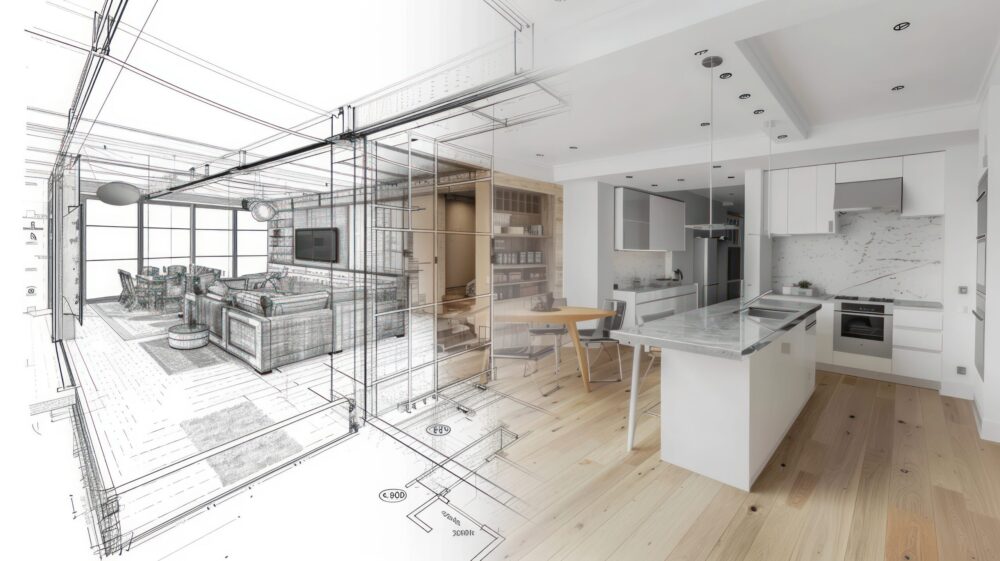
What is the CILA
The CILA (certified notice of start of works) is the building procedure for extraordinary maintenance that does not affect the structural parts of the building. It is submitted to the municipality together with the sworn statement of a qualified technician, who certifies that the works comply with planning and building rules. There is no need to wait for an authorisation: works can start on the day it is submitted.
When the CILA is needed
The CILA covers, for example:
- moving, opening or demolishing non-load-bearing partition walls;
- redoing bathrooms and kitchens with changes to the systems;
- splitting or merging property units without structural works and without a change of use;
- redoing the roof covering without works on the structure;
- restoration and conservative rehabilitation without structural works.
Works on the structure require a SCIA instead; new buildings and extensions usually require a building permit. Ordinary maintenance, such as painting or replacing floors, is free building work and needs no application.
How it works
- Site inspection and check of the property’s legal status;
- Project showing the current state and the planned state;
- Sworn statement by the technician, certifying that the works comply with the rules;
- Submission to the municipality through its online portal: works can start immediately;
- When the works are finished, end-of-works notice and, if the layout changes, cadastral update.
The municipality can check the application even after the works have started and, if it finds irregularities, ask for additional documents or apply penalties.
Our service
We handle the whole procedure: preliminary check, project, sworn statement, submission, end of works and cadastral update. If the works qualify for a tax deduction, we also prepare the technical documents you need for the bonus.
Frequently asked questions
Is VAT added to the price?
No. The studio uses Italy’s flat-rate tax scheme (regime forfettario, art. 1, paragraphs 54–89 of Law 190/2014), so no VAT is charged on its services.
Are there any additional costs?
Ancillary costs are added to the price, such as administrative fees and any urbanisation charges required by the municipality for the application, plus the works supervision fee, if requested.
What are the works supervision fees?
Works supervision fees cover overseeing and coordinating the building works, so that the project is carried out as agreed in the contract.
How are the works supervision fees calculated?
They can be calculated as a percentage of the total cost of the works, on an hourly rate or as a fixed fee, depending on what is agreed in the contract.
When do I need to submit a CILA?
A CILA can be used for several kinds of works, including:
- Redoing the roof covering;
- Redoing the bathroom, including the systems;
- Changes of use (without structural works);
- Splitting or merging property units (without structural works);
- Restoration and conservative rehabilitation without structural works;
- Extraordinary maintenance works such as opening or changing internal doors and moving internal partition walls.
When is a CILA not needed?
A CILA is not needed if the planned works are ordinary maintenance, for example:
- Replacing windows and doors;
- Painting internal and external walls;
- Replacing kitchen and bathroom tiling;
- Installing some types of air conditioners with an output below 12 kW.
No building application is needed for these works (they are free building works), unless the property is protected or the municipality has specific rules.
When can the works start?
Works can start as soon as the documents have been filed with the competent authority; there is no need to wait for the municipality’s authorisation, although the municipality may still ask for additional documents.
What if the property is subject to restrictions?
If the works concern a protected property, we first look at the specific case and apply to the competent authority for the authorisation needed, before submitting the building application. There are several kinds of restrictions, such as archaeological, monumental, landscape, hydrogeological and woodland restrictions.
How long is a CILA valid?
National law does not set an expiry date for the CILA, but some municipal regulations set a deadline for completing the works. We check the rules of your municipality.
Can I change the submitted project?
For small changes, a final-state drawing can be submitted before the works are closed.
What if I started the works without submitting a CILA?
If the CILA was not submitted before the works started (and the works are not yet finished), a late CILA can still be submitted; the municipality requires payment of a reduced penalty of €666.00 (2/3 of the penalty for a CILA in sanatoria).
What if I carried out the works without submitting a CILA and they are already finished?
If the works are finished but meet health and hygiene requirements and comply with planning rules, they can still be regularised by submitting a CILA in sanatoria (retrospective application).
The municipality requires payment of administrative fees (depending on the municipality where the property is located) and a penalty of €1,000.00.
Which documents do you need from me?
Please provide the following documents:
- Floor plan and cadastral search;
- Owner details and identity documents.